“Just because it’s Christmas – And at Christmas you tell the truth” –Love Actually
It’s that time of year. The time of year in which Thanksgiving has actually passed and this thing called December has started and I allow myself to use the word “Christmas.”
Sometimes I like to celebrate Christmas by listening to the latest “War on Christmas” diatribe and shaking my head at how strange it is to live in a deeply religious country that occasionally pretends to be secular.
Sometimes I like to celebrate Christmas by carefully employing the phrase “Happy Holidays” to emphasize that all that D.C. area political correctness sunk in, which is why I used to know at least two elementary school choir songs about Hanukkah (and still can’t ever decide how to spell it) and one about Kwanzaa (although my main memory of that holiday is that there was one black student in my high school journalism class, and he hated the end-of-year issue because someone would inevitably ask him if people for real celebrated that holiday – a question which was justifiably met with the same eye roll a Japanese friend gave to our freshman history teacher when she was asked if she wanted to explain to the class what Buddhism meant).
Mostly I don’t play that game.
I say “Merry Christmas” because I grew up Catholic. I don’t remember what it’s called, but I know the accent mark on the script music means you’re not supposed to breathe until you finish singing “Gloria.” “O Come All Ye Faithful” doesn’t feel worth singing to me unless the first verse is in Latin.
If you’re like me, and your religious view are more complicated than they used to be, read The Best Christmas Pageant Ever to be reminded that the people you interact with here and now, in your own community, are the ones who will provide the greatest insights you will ever receive into the nature of both faith and reality. (That’s not a very good advertisement for the book – it’s short; it’s hilarious; it’s heart-warming in a mainly non-schmaltzy way; it features kids of the so-not-cute-they’re-adorable variety; for real, go read it.)
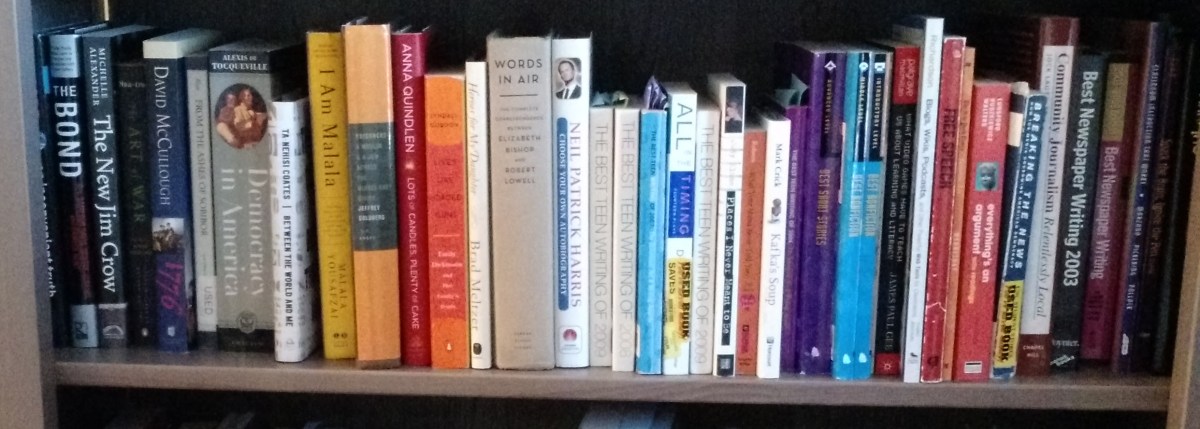
Now that I’ve finally gotten to the ostensible purpose of this post, here are my ruminations on the books that deserve to be on your holiday reading list (and before you say, “Only an English teacher would perpetuate the idea of a reading list in a season that is clearly built for socially-sanctioned bingeing of the sugar / alcohol / shopping / TV / sporting event / anything-else-real-Americans-might-actually-want-to-indulge-in variety,” I would like to remind you that books provide excellent fodder for amusing cocktail party banter, convenient excuses for retreating from whatever chaos has engulfed your home, and time-tested ways to make Santa appear faster … at least one of which is true).
A Holiday Reading List for Anyone (but mainly those who enjoy both sarcasm and earnestness enough to have read this far):
DON’T BOTHER WITH THIS ONE:
*Purity: A Novel by Jonathan Franzen: The pompousness of the post-colon part of its title, or the fact that I hated The Corrections, should have been enough to prevent me from picking up this book. But it’s about sunshine laws! (Which I believe in) And it’s about the Bay Area! (Where I now live) And those are the only two exclamation marks I can justify employing for a book which in less than 200 of its more than 500 pages had so many “please don’t go there … oh, you just did” moments that I came away thinking, “Why am I reading a book in which the interior monologue of the narrator and the dialogue (both spoken and emailed – this book does try very hard to be of-the-moment) reinforce everything I hate about the dynamics of gender in our society?” I know it’s supposed to be commentary. I know many, many people will say I missed the point and should have read to the end. To each his own. If I want to reflect upon whether or not arrogance can ever actually be charming, I just go re-read Pride and Prejudice.
DEFINITELY BOTHER WITH THIS ONE:
*I Am Malala: The Girl Who Stood Up for Education and Was Shot by the Taliban by Malala Yousafzai and Christina Lamb: Yes, the post-colon part of this title gives away the ending. The best part of the book is that it in no way gives away the main point. This book has been sold as a hero story, and it absolutely is that. It’s also an achingly beautiful tribute to a lost homeland, a loving family, and a struggle that is in no way over.
JOIN ME IN ATTEMPTING TO FINISH THESE TWO:
*A People’s History of the United States by Howard Zinn: I’ve been trying to finish this book since August. (See the first line of this blog post – sometimes people with long reading lists don’t finish everything.) Before August, the only part of this book I’d read was the section about Columbus, which is helpfully (I say that with no trace of sarcasm) circulated around the Internet each year on Columbus Day. I did cheat and skip ahead to the end (considering the current state of global politics, the closing chapter on the War on Terror felt useful). In the actual narrative flow of the book, I have made it past Robber Barons and am now drowning in the details of various labor movements, feeling vaguely ashamed at how much I am flailing in my efforts to keep any of the names straight, while reminding myself that’s the whole point (I went to quality public schools; I had quality history teachers; I learned a lot more about the most successful capitalists than I did about those whose labor built the world.)
*Midnight’s Children by Salman Rushdie: This has also been a work-in-progress since August. I don’t believe prose is a word that can be accurately applied to anything Rushdie writes. The poetry of his verse is undeniable; the digressive narration is endearing; the allegorical plot is nearly unintelligible without an accompanying history textbook. I know enough about that area of the world to pretend that I can understand this book without further research. That is maybe true, on a first read. This is undoubtedly a book that will require more than one read; I think it’s worth it.
EDUCATE YOURSELF IN THE BEST WAY POSSIBLE:
*The Fire Next Time by James Baldwin: If you read the intro to this post and thought “meditating on the nature of religion in America deserves a much more mature and thoughtful reflection than these few flippant paragraphs,” then you should read Baldwin’s reflections on Christian ministry and the Nation of Islam. I’m more than a little in awe of Baldwin; I will write another post that will consist mainly of his words, because they’re much more worth reading than anything that I have to say about them. Read this book. Then read:
*Between the World and Me by Ta-nehisi Coates: Or read Coates and then read Baldwin, depending on whether or not you want to read the contemporary narrative and then its historic inspiration, or the other way around. I read Coates first. I’m not sure you can truly understand how heartbreaking his letter to his son is until you read Baldwin’s letter to his nephew, reflect on how many decades passed between the writing of those two letters, and then think about how little has changed. And why. Think about the why. Paying lip service to the myth of “colorblind America” doesn’t produce an actual, productive dialogue. Such a dialogue requires listening. It also requires research.
*Drink Cultura by José Antonio Burciaga: The Last Supper of Chicano Heroes, the posthumous collection of Burciaga’s work, which I immediately started after finishing Drink Cultura because Burciaga is the kind of author who you read once and then immediately want to immerse yourself in, contains this cover blurb from Alma Luz Villanueva: “José Antonio Burciaga is, all at once, deeply humorous, profound, angry, amused – which I think translates to brilliance.” Amen.
ADD SOME LIGHTNESS TO YOUR LIFE:
*Yes Please by Amy Poehler: The most refreshing part of this book is how candidly Poehler admits that there are some things which are just too painful to write about. Lots of memoirists try to pull off the “I’m just not going to talk about this” act, but not that many do it explicitly or well. More importantly, this book will make you laugh out loud. The kind of laugh that deserves the full spelling, not just the acronym. Also, it inspired me to finally jump on the Parks and Recreation train, which is going to be a big distraction from my efforts to complete any further reading. But worth it. (So is Aziz Ansari’s latest, Master of None, if you’ve already had your Netflix fill of Parks and Rec and need a new addiction.)
END WITH THE GRANDE DAMES (because they deserve it):
*Heartburn by Nora Ephron: There is at least one genuinely funny book about divorce. It’s called Heartburn. I often find it difficult to explain my views on relationships without quoting When Harry Met Sally. I find it equally difficult to explain my views on journalism without referencing All the President’s Men. Apparently it didn’t end well for those two. The book ends pretty fabulously.
*God Save the Child by Toni Morrison: Take everything I said in the first entry on this list about how frustrating it is to read a book that is praised for its biting dissection of our current moment and find out it’s actually just a recycling of outdated stereotypes, delete it, and then write, “Read more Toni Morrison” in its place. Fair warning: Spare prose doesn’t mean an easy read when Morrison is in charge. She’s in charge for a reason.
Happy reading, y’all 🙂
 Elizabeth DeOrnellas